Did you know it’s possible to teach children as young as elementary schoolers about something as complex as color theory? Golden Road Arts works with teachers and local school districts to make art in the classroom enjoyable and engaging. Today we’ll share our tips for introducing color theory to young children and preteens.
Teaching Kids the Color Wheel With Free Art Lessons
Before we dive into our tips we’ll briefly introduce the color wheel. The color wheel is a visual representation of the spectrum of hues and their relationships to one another. This chart is foundational to color theory even at higher levels of learning.
The color wheel may be depicted in a few ways, such as a series of concentric circles, a Venn diagram, or a circle with nodes and lines highlighting the relationships. These relationships are displayed in three main categories: primary, secondary and tertiary (or intermediate) colors. Learn how the color wheel can be used to explain pigment and binder with this free lesson.
4 Tips to Teach Children About Color Theory
Art is literally everywhere, as we are surrounded by color, moments, and ideas to capture. This makes it easier to introduce topics like color theory to children, since the opportunity to highlight parts of the theory are always around.
1. Use age-appropriate terminology
Art is usually exciting for children, but there’s nothing like the use of the word “theory” to make it seem more formal. While older children may know more about harmony, spectrum, and related concepts, make sure you engage your youngest learners with terms that fit their understanding.
2. Encourage kids to explore and make a controlled mess
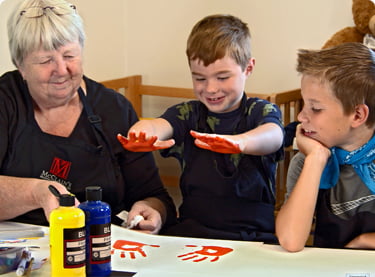
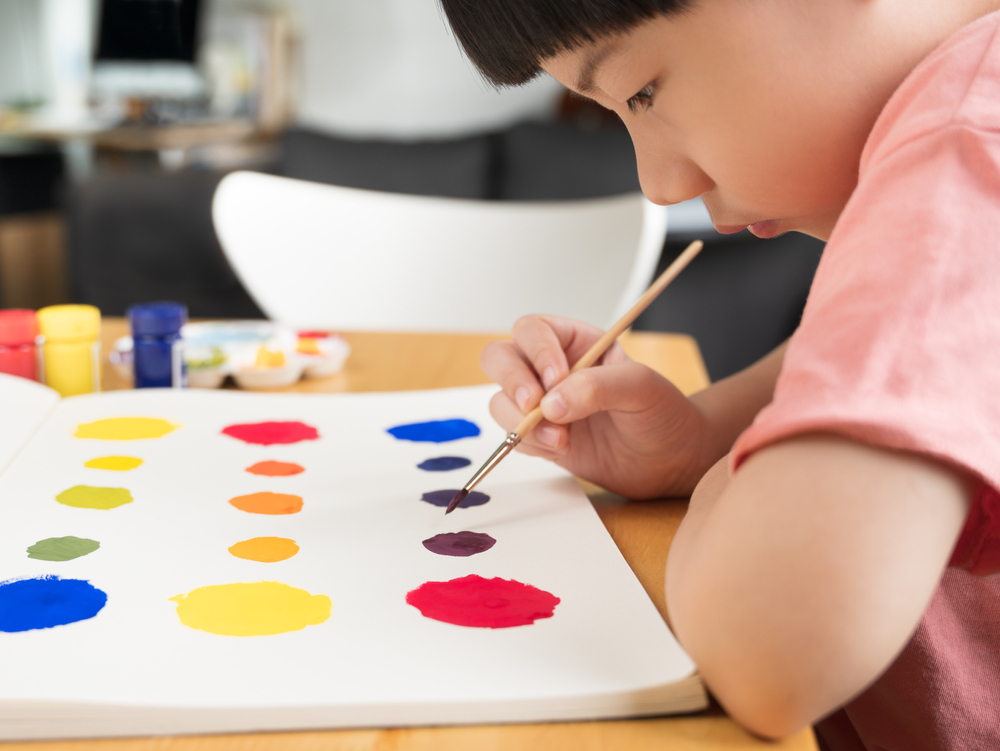
Part of the fun of making art is the willingness to get a little messy. After you’ve presented and explained a high-level overview of colors, encourage children to test what they know. Their hands-on engagement will help them grasp what words alone may not. Mixing paint or using color pens and markers to make projects (like their own color wheels) are a great way to do this. Make sure to have smocks and lots of paper towels on hand.
3. Use multiple media to show off color
Paint is often the first medium to come to mind for teaching color theory as it mixes easily and shows color relationships via various pigments. And of course, colored pencils and crayons are easily accessible. Another great item to use is color translucent film or thin vellum paper. These can be layered to show off the properties of color.
4. Use storytelling and song
When information is presented via song or poetic storytelling formats it’s easier to recall, and also adds even more fun to the experience. It also adds another layer of art (performing arts and writing) into the mix. While you may not be testing your students on their understanding of color theory at younger levels, as they go along in their schooling these things can be recalled. When they’re older, children will discuss color theory as it relates to light in science classes.
Color theory lessons provide children with skills, understanding and confidence, and can show how art touches more than creative subjects. This learning gives them a chance to see how different components can work together to make something new. A child can learn color theory and so much more with our free art activities for children.
Find and Support Free Art Lessons for Kids Online Today
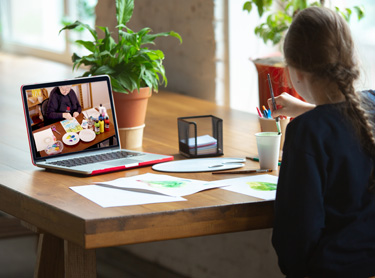
Supplement your art class or have an art-centered family time with our free kids’ online art lessons. To help us in our endeavors please consider donating to our nonprofit to support children’s creative development.